

High performers don't break suddenly. They erode gradually. The ones who stay sharp don't wait to find out.
Some people come to me when something already feels off — the edge is sharper, the recovery slower, the patience thinner. Others come when everything is working, and they want to keep it that way, or reach what's next. Both represent the right moment to look clearly at what is happening, where it is heading, and what to do about it. I work with both. Both need the same thing: clarity, honest diagnosis and feedback, and a structured path forward.
That is what I do. I help you identify where you actually are, what the next level requires, what, if anything, is getting in the way, and what might push you forward — whether that means recovering capacity, developing leadership, or using what you are already good at more deliberately.
The cost of inaction
Investing in leadership development, coaching, and capability building is not a welfare initiative. It is a performance decision.
- Coaching generates measurable returns. Organizations that tracked financial outcomes reported a median return of 5x to 7× the investment. (ICF / PwC Global Coaching Client Study)
- Mental health directly affects productivity. Depression and anxiety cost the global economy 12 billion lost working days every year — roughly US$1 trillion in productivity. (WHO / ILO)
- Burnout is not a Western problem. In Romania, 2 out of 3 workers reported experiencing burnout or being on the verge of it — the second highest rate in Europe. The problem is here, and it is not getting the attention it deserves. (Statista, European survey data, 2022)
- Disengagement is a macroeconomic problem. Low employee engagement costs the world economy US$8.9 trillion annually — about 9% of global GDP. (Gallup State of the Global Workplace)
- Leadership behavior shapes engagement. Managers account for around 70% of the variance in team engagement. Leadership quality is therefore a core performance lever. (Gallup workplace research)
- Skills gaps are already hurting performance. 70% of executives report that capability gaps are negatively affecting business results, with strategic and critical thinking cited as the most urgent development need, and problem-solving and decision-making coming in second. (Springboard Workforce Skills Gap Report)
Evidence varies by context; claims are used as directional business framing and should be validated in your organization.
Coaching
I work in three main coaching areas. Each with its own process, tools, outcomes, and room to adapt to each client's uniqueness.
Do you feel that something is off, or is everything fine?
Good. You're either right, or you're not ready yet. Either way, you know where to find me.
You don't need to name it precisely. Most people can't, at first.
What they do know is that effort and output no longer match the way they used to. That recovery takes longer. That the version of themselves they're used to being feels further away than it should.
That gap has a structure. And structure can be worked with. I work with people who are still functioning, still delivering, and quietly running a deficit they haven't told anyone about. Not because they're weak. Because they're the kind of person who figures things out alone. This is where we figure it out together. Faster. With less damage.
Are you leading well, or are you managing the appearance of it?
Good. That's harder than most people admit. If you ever feel a discrepancy between your reality and how others perceive you, you know where to find me.
Most leadership problems don't announce themselves as leadership problems.
They show up as a team that executes slowly. A conversation that keeps happening without resolving. A decision you made well but couldn't explain clearly enough for others to trust it. A version of yourself in meetings that is competent but not convincing enough.
These are not personality problems. They are thinking and communication patterns. Specific, observable, and trainable. I work with executives and founders who are already good at what they do and have hit a ceiling that effort alone won't raise. We work on specific, observable patterns: how you think, how you listen, how you act under pressure, and where the gap is between your intent and your impact.
Do you know what you're actually good at, or do you rely on what you've been told?
Good. Most people confuse performance under pressure with genuine strength. If you ever want to test that distinction, you know where to find me.
There's a difference between what you're capable of doing and what you do best.
Most people spend most of their career in the first category. The second is where energy, speed, and quality converge without force. CliftonStrengths is a Gallup assessment that identifies your 34 talent themes in ranked order. Taking the assessment is not the work. Most people take it, read the report, and file it.
The work is what comes after: understanding which of your strengths are actually driving your results, which are creating friction you've been attributing to other causes, and how to build your role, your habits, and your team interactions around what's genuinely there.
Example for the process of a coaching program
- Session 1: clarify objectives, boundaries, confidentiality, and success criteria.
- Sessions 2–3: exploration & awareness (stress signals, beliefs, blind spots, behaviors, context).
- Session 4: build a plan (experiments, habits, communication methods).
- Sessions 5–6: weekly iterations (what worked / what didn't / what's next).
- Session 7: integration — sustainable routines & measurable progress indicators.
Coaching is a complex and precise process that has the client at its center. It is continuously adapted by the coach to the client's needs, the coach acts as a partner, not a guide.
Trainings
Three main topics. Depth and format are adapted with the client (half-day to two days).
Does your team handle pressure well, or have they just stopped mentioning it because it became the norm?
Good. That's either true, or it's what high-performing teams say until the numbers change. If the numbers change, you know where to find me.
Silence is not resilience. In most high-performing teams, the people carrying the most weight are also the least likely to raise their hand.
What you typically see instead: slower decisions, shorter tempers, the gradual exit of your best people for reasons that don't fully add up. By the time it's visible, it's already been building for months.
This training addresses three specific problems: how to recognize overload before it becomes absence, how to have direct conversations about pressure without it feeling like weakness, and how to build team habits that sustain performance without burnout. No guided breathing. No motivational framework. Just tools that work on a Tuesday morning when the business is not going well.
Are you sure your team thinks well under pressure, or do you prefer to believe they do?
Good. That's rare. If you ever want to verify it, you know where to find me.
Most teams don't have a knowledge problem. They have a reasoning problem.
Smart people, good data, wrong conclusions. Decisions that made sense in the room and fell apart in practice. Problems that were solved efficiently but weren't the actual problem. Assumptions nobody questioned because everyone assumed someone else had.
This is not a failure of intelligence. It's what happens when thinking skills are never treated as trainable. One workshop won't close that gap permanently. It will show the team exactly where the gap is, and give them a framework to start closing it themselves.
Do the people around you perceive and understand you as you intend?
Good. Most leaders find out they're wrong about this at the worst possible moment. If that moment comes, you know where to find me.
Every leader has a gap between what they mean and what people perceive. The gap is rarely in the words.
It's in the two seconds of silence before you respond that read as judgment. The posture in a difficult conversation that says you've already decided. The tone on a video call that communicates stress your message was trying to hide.
These signals follow patterns, and patterns can be identified, practiced, and changed. This training is practice-heavy by design: role plays, recorded feedback, real scenarios from your workplace. You will see yourself from the outside. That is uncomfortable. It is also the only way this changes.
Other topics (available on request)
You have additional needs. I keep the homepage focused; in a discovery call we scope the exact agenda, examples, and deliverables.
About
Stamin Daniel
Twenty-five years of business experience across oil and gas, pharma, FMCG, finance, and a dozen other industries. Management consultant, trainer, coach.

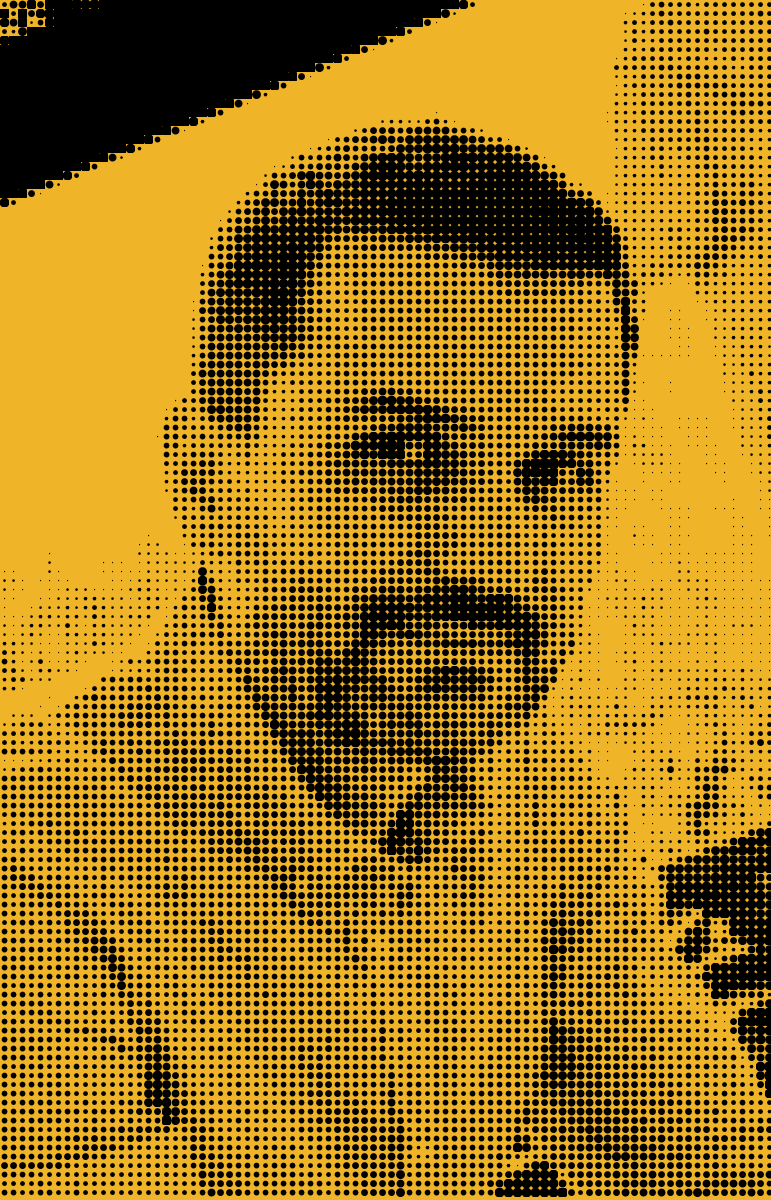
After 14 years of experience training people in behavioral and leadership skills, I'm convinced that one of the most important skills is deceleration. It is the ability to slow down when necessary, stop applying pressure, and start listening. My coaching experience has only deepened this conviction.
Over 1,000 hours of one-to-one and team coaching since 2015. I bring the structure of a consultant, the patience of a trainer, and the self-awareness of a recovering perfectionist who is still very much in recovery.
Who I work best with
Most leaders call me when something feels off. Some people who reach out already know what the problem is. Insight isn’t their issue — they think they have plenty of that. What they don't know yet is that they need someone who will not let them leave the conversation with a comfortable half-truth.
That's what I do. I've been a consultant, a trainer, a coach. Three different job titles for the same uncomfortable function: making it harder to stay exactly where you are.
I don't take every client. Not because I'm selective in a marketing sense — but because some people just want to feel validated for not changing, and I'm genuinely bad at providing that. If you need someone to validate comfortable yet harmful behaviours you've already decided on keeping, I'm the wrong person.
I keep confidentiality beyond what contracts require. I refer when someone needs a therapist and not a coach. I end engagements when I'm no longer the right person for the work. I don't adjust my feedback based on who's paying. Some call that idealistic. Some call it counterproductive, from a business perspective. I call it normal — if you have the right values.
Credentials

FAQ
Is coaching the same as therapy?
No. Coaching is forward-focused and action-oriented. I do not diagnose or treat mental illness. If clinical support is needed, I refer appropriately.
How do I know if I'm stressed or burned out?
We assess symptoms and context. Burnout is occupational and typically includes exhaustion, cynicism/mental distance, and reduced efficacy.
How long is a coaching cycle?
Typical individual cycles are 7 sessions. Teams often run 6 sessions of 2–4 hours depending on group size and goals.
Do you work with companies?
Yes—leadership coaching, team coaching, and trainings (4–16 hours). We define scope, success criteria, and confidentiality boundaries upfront.
Where do sessions happen?
Online or in-person (Bucharest, Vienna). For corporate work: on-site or online.
What's the fastest first step?
Book a short call. We clarify the problem, desired outcomes, and the simplest plan that creates momentum.
What languages do you coach in?
Romanian, English, and German. Sessions are held in any of the three languages. Contracts and written materials are available in Romanian and English. German available on request.
What does a typical session look like?
Sessions are 50 minutes. We start from where you are—what happened since last time, what shifted, what is still stuck. I ask questions that make it hard to stay vague. You leave with one or two clear moves, not a long list.
Is everything confidential?
Yes. Confidentiality is a core part of the coaching agreement—on my side it is unlimited in time. For organizational mandates, we define the reporting boundaries at the start, and they are explicit in the contract.
What is coachability?
Coachability is the ability and willingness to reflect honestly, receive challenge and feedback, and turn insight into action. If you want a deeper look, read more about coachability.
The DROP
Published on Substack. Articles on stress, leadership, performance, and clear thinking — for people who prefer substance over inspiration quotes.


Book a session
Choose the format that fits your need, then select a suitable time.


For corporate programs and team coaching, reach out by email — scope and format are better defined in a short conversation first.
Contact


Not all intention is equal
The goal of a coaching program should not be to recover enough to go back to what broke you in the first place.
The ambition of a clear thinker should not be to outsmart their peers.
The purpose of a good non-verbal communicator should not be to project a false image of who they are.
If those are your reasons, we're not on the same ethical ground. If none of that describes you, I'm looking forward to meeting you.
GDPR note: contact data is used only to respond to your request and is not sold or shared.